
Artistic Home Decor for Rental Apartments: 2026 Guide
Table of Contents
- Why Rental Apartments Are Perfect for Artistic Home Decor
- How to Choose the Right Size Art Print for Small Walls
- Damage-Free Art Hanging Methods That Protect Your Deposit
- Curating a Gallery Wall in a Rental Without Losing Your Security Deposit
- Temporary Wallpaper, Textiles, and Lighting Upgrades for Renters
- Acoustic Art and Artistic Storage: Two Rental Decor Angles Most Guides Miss
- Conclusion: Making Your Rental Feel Like a Gallery
- Frequently Asked Questions
Last Updated: October 1, 2026
Why Rental Apartments Are Perfect for Artistic Home Decor
Rental apartments are ideal for artistic home decor: blank walls, flexible layouts, and freedom to experiment without long-term commitment. At This Artists Dream, we see renters turn plain units into personal galleries every day. Choose pieces that move with you.
- Blank walls give you a clean canvas for gallery walls and large canvas prints
- Temporary fixes mean zero risk to your security deposit
- Small spaces reward bold, focal pieces instead of clutter
- Every change is reversible, so you can redecorate as often as you like
How to Choose the Right Size Art Print for Small Walls
The right size art print for a small wall fills roughly two-thirds to three-quarters of the wall's width. On a narrow wall, one 14" x 10" canvas beats a cluster of tiny frames.
| Wall Width | Best Art Width | Example Piece |
|---|---|---|
| Under 30 inches | 10-14 inches | Small canvas print |
| 30-60 inches | 20-36 inches | Stretched canvas |
| 60-90 inches | 36-48 inches | Large statement piece |
| Over 90 inches | 48+ inches or a gallery wall | Multiple pieces |
Damage-Free Art Hanging Methods That Protect Your Deposit
Damage-free hanging methods let you display art without nails, screws, or wall damage. The safest options, removable adhesive strips, magnetic systems, and tension rods, come off clean when you move.
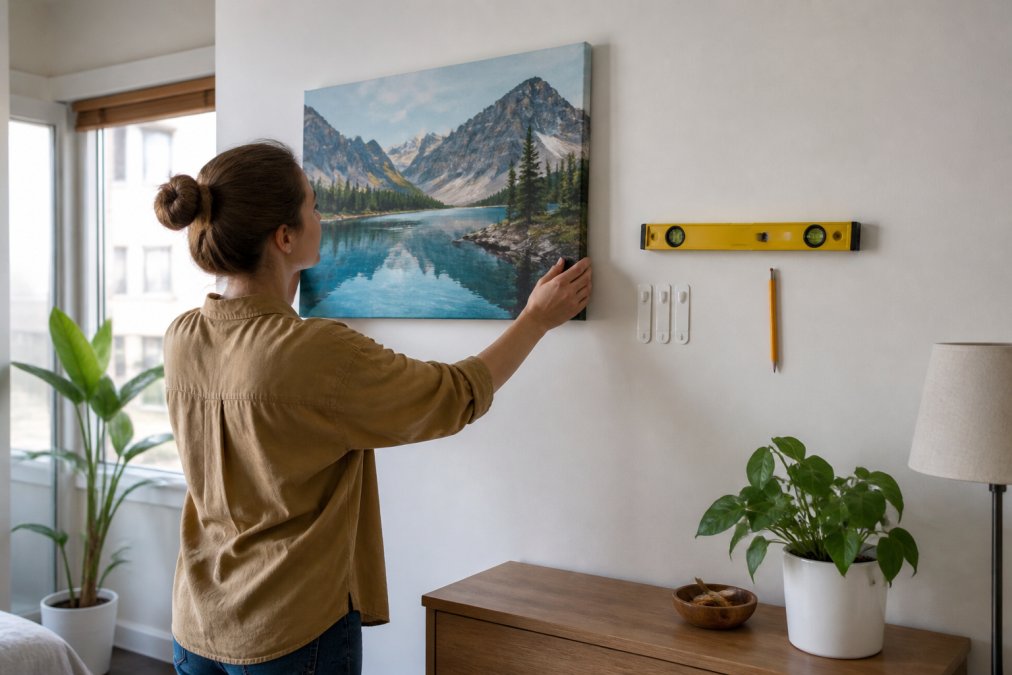
Here are the most reliable renter-friendly methods:
- Removable adhesive strips hold light to medium frames and peel off without marks
- Command strips work well for canvas prints and lightweight mirrors
- Magnetic systems let you swap art without re-hanging anything
- Tension rods fit inside window frames for lightweight tapestries
- Picture ledges rest on top of furniture and need no wall holes at all
Curating a Gallery Wall in a Rental Without Losing Your Security Deposit
Curating a gallery wall in a rental comes down to three things: planning the layout on the floor, distributing weight across multiple adhesive points, and matching the hanging method to your wall surface. Get those right and you can hang a 12-piece wall without a single nail hole.
Step 1: Plan the layout on the floor, not the wall
Lay every piece on the floor in the arrangement you want, then measure the cluster against your wall. A common pattern: the cluster spans roughly two-thirds to three-quarters of the wall width, centered at eye level (about 57-60 inches from floor to center).
Step 2: Space the frames intentionally
- 2-3 inches between frames reads as a tight, intentional grid.
- 4-6 inches between frames reads as a loose, collected-over-time wall.
- Consistent spacing within a cluster matters more than the exact number. Pick a gap and repeat it.
Mix sizes, but anchor the arrangement with one large piece. One large canvas plus three to five smaller pieces balances more easily than six medium pieces of similar size.
Step 3: Distribute weight across multiple adhesive points
This is the rental-specific mechanic most guides skip. A single strip holding a 3-lb frame is a single point of failure; two strips near the top corners share the load and survive temperature swings better.
A few rules that hold up in practice:
- Use two strips for anything over 1 lb. One strip per pound of art is a reasonable starting ratio, but never rely on a single strip for a framed piece.
- Press and hold for the full time on the package, usually 30 seconds, then wait the recommended cure time (often 1 hour) before hanging. Most adhesive failures trace back to skipping the cure time.
- Clean the wall first. A wipe with isopropyl alcohol and a full dry removes the oils and dust that cause early release.
- Avoid hanging adhesive-mounted art above heat sources, radiators, space heaters, and direct afternoon sun on a south-facing wall all weaken the adhesive over time.
Step 4: Match the method to the wall surface
- Painted drywall, cured: removable adhesive strips work well.
- Fresh paint (under 30 days): adhesive can lift the paint. Wait, or use a picture ledge.
- Textured walls (orange peel, knockdown): adhesive contact is unreliable. Lean art on ledges or use floor-standing easels.
- Brick or concrete: adhesive will not hold. Use a leaning arrangement or a freestanding screen.
- Wallpaper: adhesive can tear the paper. Lean, do not stick.
Step 5: Document before you hang
Photograph the bare wall, then the finished arrangement. If a strip leaves residue at move-out, the bare-wall photo proves the wall was clean before you started. Keep both with your lease.
David Heatwole Particles Premium Pillow →
Temporary Wallpaper, Textiles, and Lighting Upgrades for Renters
Temporary wallpaper, textiles, and lighting upgrades give renters the biggest visual change for the least effort, but only if you pick the right sub-type for your wall. The wrong peel-and-stick adhesive will either peel off in a week or take paint with it when you move.
Temporary wallpaper: match the backing to your wall
Most peel-and-stick wallpapers fall into three backing types, and each behaves differently on rental walls:
- Vinyl with removable adhesive, the most common. Grips smooth, painted drywall well and peels clean if the paint is fully cured (typically 30+ days after painting). Struggles on fresh paint, flat/matte finishes, and textured walls.
- Woven or fabric-backed peel-and-stick, heavier, more forgiving of minor wall texture, and less likely to tear on removal. Costs more per roll and needs a smoother hand to install without bubbles.
- Traditional prepasted wallpaper activated with water, not truly renter-safe. It can lift paint and leave residue. Skip it unless your lease explicitly allows wallpaper.
Textiles: the cheapest way to soften a hard rental
Apartments with hard floors, bare walls, and tall ceilings echo. Textiles absorb sound and add color at once. The renter-friendly moves:
- Tapestries hung with a tension rod inside a window frame, or with removable adhesive clips along the top edge. A lightweight cotton or polyester tapestry under 3 lbs is safe on adhesive; heavier woven pieces need a proper rod.
- Curtains on tension rods, no drilling, no brackets. Measure the inside of the window frame, not the outside, and add 1-2 inches of tension so the rod does not slip.
- Woven throws and macramé hangings on a decorative ladder or an over-the-door hook. These add texture without touching the wall.
- Rugs, the single highest-impact textile for echo. A 5x8 rug under a bed or sofa cuts reflected sound noticeably in a hard-floored room.
Lighting: three changes that do the most work
- Swap the bulbs, not the fixture. Most rental ceiling fixtures take standard E26 base bulbs. Replacing cool-white 5000K bulbs with warm 2700K bulbs at the same lumen output changes the entire mood of a room for a few dollars per bulb. Match the lumen rating to the old bulb so the room does not get dimmer.
- Add a plug-in sconce where you want wall light without an electrician. Plug-in sconces run a cord to the nearest outlet; hide the cord with a paintable cord cover or route it behind furniture.
- Use a picture light above a canvas. Battery-operated LED picture lights and plug-in versions both exist. They make a single piece read as intentional rather than incidental, which is the fastest way to make a rental wall look curated.
- Layer a floor lamp in a corner. One warm floor lamp in the darkest corner of a room does more for perceived coziness than any overhead fixture.
Every upgrade in this section reverses completely: wallpaper peels, tension rods lift out, bulbs unscrew, plug-in fixtures unplug. That reversibility makes them safe for apartment living, and worth doing even if you move in a year.
Acoustic Art and Artistic Storage: Two Rental Decor Angles Most Guides Miss
- Floating shelves styled with small prints and objects
- A decorative ladder for throws and textiles
- Woven baskets that double as sculptural accents
- A console table that holds art and hides cables
Sustainability matters here too: durable canvas prints and natural textiles over disposable decor mean fewer replacements and less waste each move.
Conclusion: Making Your Rental Feel Like a Gallery
Turning a rental into a gallery is about smart choices, not big budgets. Damage-free hanging, the right print sizes, and reversible upgrades let you decorate boldly and move without worry.
Frequently Asked Questions
How can I hang art in a rental without damaging walls?
Use removable adhesive strips or hooks rated for the weight of your piece. Command strips work well for lightweight prints under 5 pounds. For heavier canvas prints, use removable picture hangers that leave minimal holes. Always clean the wall with rubbing alcohol before applying adhesive, and follow the removal instructions carefully to protect your security deposit.
What is the 3-5-7 rule in decorating?
The 3-5-7 rule suggests grouping decorative items in odd numbers for visual balance. Apply it to gallery walls by clustering three small prints, five medium pieces, or seven mixed-size items. Odd numbers create natural movement for the eye. Pair this with a consistent color scheme or theme so the arrangement feels intentional rather than cluttered.
What are the best renter-friendly ways to display large-scale art?
Lean oversized canvas prints against the wall on a console table or floor for a gallery feel without hardware. Use tension rods inside window frames to hang tapestries or lightweight textiles. Magnetic systems work on metal surfaces. For wall mounting, use removable adhesive hooks rated for heavier weights, and always check the weight limit before hanging.
How do I choose the right size art print for small walls?
Measure your wall space and aim for art that covers 60 to 75 percent of the available width. For narrow walls under 3 feet wide, choose prints 12 to 18 inches wide. A single statement piece often works better than several small items on a tight wall. Hang art so the center sits 57 to 60 inches from the floor for comfortable viewing.