
Why Independent Art Costs More: The Real Breakdown
Table of Contents
- The Price Tag on Original Artwork Isn't Just About the Painting
- The Real Cost of Art Supplies for Artists
- Pricing the Invisible: Labor, Studio Rent, and Overhead Expenses
- The Gallery Cut and the Cost of Failure in the Art Market
- Digital vs. Physical Overhead: Why the Location of Art Matters
- How to Price Original Artwork: A Practical Framework for Buyers
- Why Supporting Independent Artists Changes What You Pay
- Conclusion: The True Value of Artistic Labor
- Frequently Asked Questions
Last Updated: September 7, 2026
The Price Tag on Original Artwork Isn't Just About the Painting
When you buy a print from a big-box retailer, you are paying for ink and paper. When you buy original artwork, you are paying for a decade of practice, a studio lease, and the quiet risk of creating something that may never sell. That gap is why independent art costs more.
At This Artists Dream, we feature the visionary art of David Heatwole, and we understand the real economics behind every piece. The independent art market operates on a simple truth: the price reflects the full cost of a professional practice, not just the materials on the canvas. This guide breaks down where your money actually goes, so you can buy with confidence and support the artists you love.
Most buyers assume the markup on original artwork is pure profit. The reality is far more complex: what looks like a high price tag often barely covers the expenses required to make art sustainably. Below, we walk through the true cost structure and give you a practical framework for evaluating what you pay.
The Real Cost of Art Supplies for Artists
Quality art supplies are expensive, and professional artists cannot cut corners. The price difference between student-grade and professional-grade materials is not a marketing gimmick; it is a direct reflection of pigment load, lightfastness ratings, and binder quality. A single 37ml tube of professional-grade oil paint can cost between $15 and $25 (dickblick.com). A large pre-stretched canvas, say 48 by 60 inches, runs $80 to $150 depending on the weave and whether it's gallery-wrapped (utrechtart.com). For a painter working in series, these costs multiply quickly across a year of production.
- Professional paints: Pigment density and lightfastness drive prices up. A high-quality paint requires fewer layers to achieve opacity, saving time and material in the long run.
- Canvases and panels: Larger formats require heavy-duty framing and bracing to prevent warping. A 60-inch canvas may need custom crossbars, adding $20 to $40 per piece.
- Brushes and tools: A single high-quality sable brush can cost $30 to $60 (jerrysartarama.com). Synthetic brushes are cheaper but wear out faster, requiring replacement every few months for daily studio use.
- Solvents, mediums, and varnishes: Odorless mineral spirits, linseed oil, and archival varnish are recurring purchases. A gallon of quality solvent runs $25 to $40.
Art supplies are a recurring monthly expense that continues whether or not a single piece sells. Many artists maintain a material budget consuming 10 to 20 percent of every sale before they see income. For a painter producing 20 pieces a year, annual material costs can easily reach $3,000 to $5,000, excluding framing or shipping.
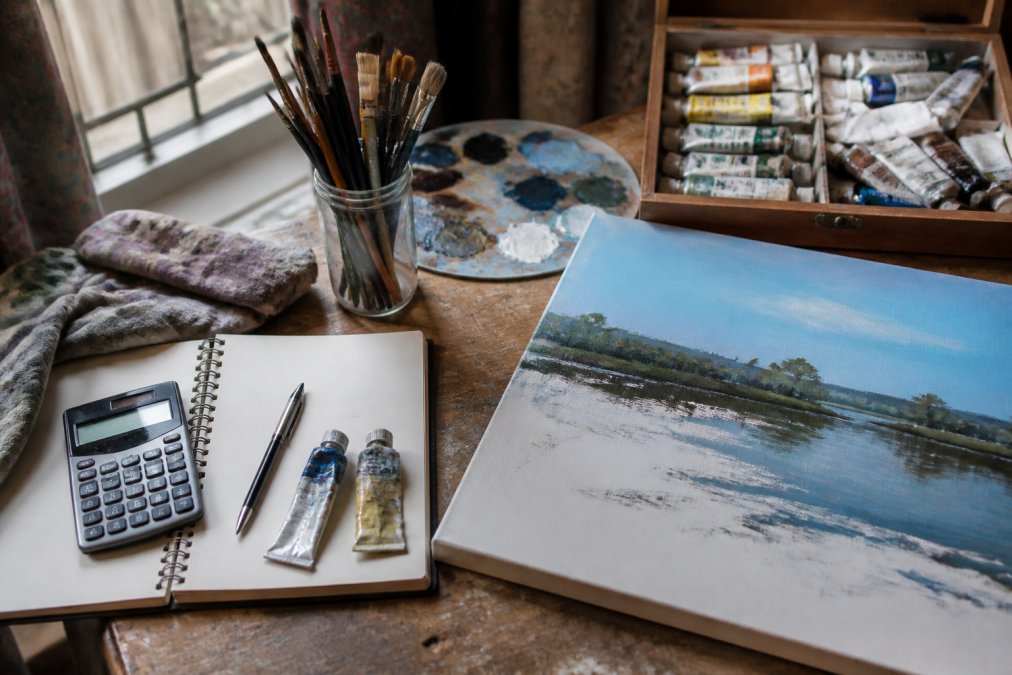
Beyond the basics, there are hidden material costs that rarely appear in a price breakdown. Stretcher bars, archival storage sleeves, and acid-free backing boards add up. Framing a single large piece for exhibition can cost $200 to $500 if done professionally, and many artists frame multiple pieces per show. Shipping supplies, including custom cardboard boxes, foam corner protectors, and glassine paper, add another $15 to $30 per piece shipped.
There is also the cost of materials that failed during the creative process. A painting that does not work out may be scraped down and repainted, but the canvas has already been stretched and primed, and the paint already applied. Some canvases are simply discarded. This waste is not inefficiency; it is the cost of experimentation. Professional artists typically budget for material loss from failed works, a figure absorbed by the pieces that do succeed.
Pricing the Invisible: Labor, Studio Rent, and Overhead Expenses
The hours an artist spends in the studio are only part of the story. Every painting represents labor beyond the visible brushwork: research, sketching, color studies, and the mental energy of developing a cohesive body of work. This artistic labor is real work deserving fair compensation.
Studio rent is one of the largest overhead expenses an artist faces. A dedicated workspace costs real money each month, spread across the artwork produced there. Utilities, internet, and equipment maintenance add to the burden, as do workshops, courses, and travel to galleries that rarely generate immediate income.
Many independent artists face significant financial challenges once overhead is accounted for. The price of original artwork is not inflated; it is often barely sustainable. Supporting independent artists means recognizing their prices reflect a real business operation, not a hobby.
The Gallery Cut and the Cost of Failure in the Art Market
When an artist sells through a gallery, the standard commission fee takes a significant percentage of the sale price. The gallery cut covers the gallery's rent, staffing, and marketing, but it means the artist receives only a fraction of the listed price.
The art market also carries a hidden cost: the cost of failure. For every painting that sells, an artist has produced several that did not, consuming materials, studio time, and creative energy. This research and development cost must be absorbed by the pieces that do find buyers.
- Gallery representation: A large commission on every sale
- Art fairs and exhibitions: Booth fees, travel, and shipping
- Marketing and photography: Professional documentation is essential
- Rejected or unfinished works: Costs that never see a return
Pricing formulas based purely on size and materials miss the point. The price of a finished painting carries the weight of the artist's entire practice, including work that will never hang on a wall. Buying directly from an independent artist or a brand that works directly with one eliminates middle layers, so more of your money reaches the creator.
Digital vs. Physical Overhead: Why the Location of Art Matters
The distinction between digital and physical art changes the cost structure dramatically. A purely digital artist has minimal material costs but faces different expenses: software licenses, hardware upgrades, and digital storage. Their lower overhead per piece is why digital downloads are often priced more affordably.
Physical art carries heavier overhead. Paint, canvas, and framing are tangible costs that scale with every piece. Shipping original artwork requires careful packing, insurance, and handling. A large painting cannot be emailed; it needs crating and freight, expenses that add to the final price.
For buyers, comparing a digital print to an original painting is comparing two different products. One is a reproduction with near-zero marginal cost; the other is a unique object with real material and logistical expenses. This distinction helps justify the price difference across the art market.
How to Price Original Artwork: A Practical Framework for Buyers
For buyers, a pricing formula helps separate fair value from speculative pricing. While you do not set the price, understanding how artists calculate it makes you a more informed purchaser. The most common starting point is a cost-plus model, where the artist sums all direct and indirect costs and adds a profit margin:
Base Price = (Materials + Labor Hours × Hourly Rate + Overhead Allocation) × (1 + Profit Margin)
Consider a concrete example. A 24 by 36 inch painting uses $80 in materials. The artist spends 20 hours in the studio, and they value their labor at $25 per hour, a modest rate for a professional. Their studio rent and utilities allocate to $50 per piece. The sum is $630. Adding a 30 percent profit margin for business sustainability brings the price to approximately $820. This is the minimum viable price before any adjustment for experience or market demand.
| Cost Component | What It Covers | Why It Matters |
|---|---|---|
| Materials | Paint, canvas, brushes | Recurring, essential expense |
| Labor | Studio hours at fair wage | Compensates artistic labor |
| Overhead | Rent, utilities, equipment | Keeps the practice running |
| Failure cost | Unsuccessful works | Funds future experimentation |
| Gallery cut | Commission on sales | Covers representation costs |
This breakdown shows why value-based pricing often beats psychological pricing in the art world. Psychological pricing, like setting a piece at $495 to seem cheaper than $500, does not reflect the true cost of creation. It is a retail tactic designed to trigger an emotional response, not a sustainable business practice. Value-based pricing, grounded in the artist's actual expenses and career trajectory, is more honest and sustainable.
The transition from cost-plus to value-based pricing is one of the most significant shifts in an artist's career. Early on, an artist with no track record may price strictly by cost-plus, accepting a lower hourly rate to generate first sales. As they build a reputation and collector base, they price based on perceived value. This is not arrogance; it is a response to market signals. A piece that sells within days may be underpriced, while one that sits unsold for a year may be overpriced.
A common pattern among mid-career artists is to price by square inch, scaling cost-plus logic to larger works. A painter charging $6 per square inch would price a 24 by 36 inch canvas at $5,184. This accounts for larger works taking more time, using more materials, and carrying more visual weight. However, square-inch pricing breaks down for small, highly detailed works requiring as much labor as a larger piece, which is why many artists eventually abandon rigid formulas for a holistic assessment weighing cost, labor, scarcity, and career stage.
The subjectivity of art valuation remains, and that is part of the appeal. Scarcity, brand equity, and market demand all influence what a piece is worth. But the underlying economics follow the same logic as any small business. When you understand the difference between a cost-plus price from a new artist and a value-based price from an established one, you can evaluate whether a piece is fairly priced for its market stage.
Why Supporting Independent Artists Changes What You Pay
When you buy from a platform aggregating thousands of anonymous designers, your money supports a faceless corporation, not the creators. When you buy from a brand working directly with a single visionary artist, your purchase has a direct impact on that artist's career trajectory.
Supporting independent artists means accepting that their prices reflect real costs and valuing artistic integrity over the cheapest option. Market saturation of cheap, mass-produced designs has trained consumers to expect low prices, but those prices come at the expense of the artist's livelihood.
At This Artists Dream, we built our model around this principle. We feature the visionary art of David Heatwole on high-quality apparel, accessories, and home décor designed to be lived in, not just looked at. Your purchase directly helps the artist and supports a brand committed to artistic labor and craftsmanship. The price reflects the art, the materials, and the mission.
Conclusion: The True Value of Artistic Labor
Understanding why independent art costs more is the first step toward becoming a conscious collector. The price of original artwork is not arbitrary; it is the sum of materials, labor hours, studio rent, failed experiments, and gallery commissions. Every piece you buy carries the weight of an artist's entire practice.
When you choose to support independent artists, you are investing in creativity, sustainability, and the continuation of unique voices in a crowded world. This Artists Dream exists to make that support tangible, transforming visionary art into everyday expression through apparel and décor that celebrates an extraordinary life. Explore our collection and add a piece of meaningful, artist-designed work to your home or wardrobe.
Frequently Asked Questions
What factors contribute to the price of independent art?
Several concrete costs determine the price of independent art. These include the direct cost of art supplies, the labor hours spent creating the piece, studio rent, and marketing expenses. Artists also factor in the cost of failed experiments and professional development. Unlike mass-produced decor, an original piece carries the overhead of a single artist's practice, not a factory's economy of scale. The price reflects the full economic reality of producing a unique work.
Why is original art more expensive than mass-produced prints?
Original art is a unique object, so its price is tied to the cost of its creation. A mass-produced print spreads the initial design cost across thousands of units, making the per-unit cost very low. An original painting has a cost of goods sold that includes only one canvas, one set of materials, and the artist's full labor hours. No economies of scale exist for a one-of-a-kind piece, which is why the price point is structurally higher.
Does the cost of materials significantly impact independent art pricing?
Yes, the cost of art supplies for artists is a fundamental baseline. Professional-grade paints, archival canvases, and quality brushes are significantly more expensive than student-grade materials. For large-scale works, the cost of supplies can easily run into hundreds of dollars. Artists must cover this direct cost before they earn anything for their labor, so material costs are always a primary factor in the final price of the artwork.
How does the artist's experience level influence the cost of their work?
Experience influences price through the artist's skill and efficiency. A professional craftsperson with years of training works faster and produces higher-quality results than a beginner. However, their hourly rate is also much higher to reflect their accumulated knowledge. Additionally, established artists have a career trajectory and a body of work that supports their market valuation, which is a form of brand equity that newer artists have not yet built.
The economics of art are rarely transparent, but they do not have to be a mystery. By understanding the real costs behind every painting, you can make purchasing decisions that honor the artist's work and your own values. Get started with This Artists Dream and experience art that is made to be lived in, not just looked at.