
Artistic Home Decor for Renters: A 2026 How-To Guide
Table of Contents
- Why Artistic Home Decor for Renters Works Differently
- What Your Lease Actually Allows
- How to Choose the Right Size Art Print for Small Walls
- Damage-Free Wall Hanging Methods That Protect Your Deposit
- Renter Friendly Wall Art Ideas for Every Room
- Budget-Tiering Your Artistic Home Decor for Renters
- Sustainable and Eco-Friendly Renter Decor Choices
- Frequently Asked Questions
Last Updated: September 11, 2026
Why Artistic Home Decor for Renters Works Differently
Artistic home decor for renters is the practice of personalizing a leased space with temporary, damage-free pieces that can be removed or relocated without forfeiting a security deposit. This guide from This Artists Dream covers how to do it without losing a dollar of your deposit.
The difference comes down to ownership. You own your taste, not the walls. Every nail hole, every adhesive residue ring, every paint chip becomes a line item against money you already paid. That single constraint reshapes every decision, from what you hang to how you hang it.
Most renters overspend on pieces that can't move with them. The smarter play is buying art that survives the move.
What Your Lease Actually Allows
Your lease agreement is the only document that matters here, not generic advice from a decor blog. Read the wall and alteration clauses before you buy a single hook.
Most leases fall into three tiers of tolerance:
- Permissive: Small nails and picture hooks allowed, patching expected at move-out
- Restrictive: Only removable adhesive products permitted, no holes of any kind
- Silent: No explicit clause, which usually defaults to "return the unit to its original condition"
Ask your landlord in writing. A text or email confirming what's permitted protects you far better than a verbal yes.
How to Choose the Right Size Art Print for Small Walls
The right size art print for a small wall is one that fills roughly 60 to 75 percent of the available width, leaving breathing room on each side (thespruce.com). Undersized art on a large wall reads as an afterthought.
Measuring for Scale and Proportion
Measure the wall width, then measure the furniture beneath it, like a sofa or dresser. Your art should span about two-thirds of the furniture's width, not the full wall.
A few practical rules that hold up in real apartments:
- Hang art so its center sits at eye level, roughly 57 to 60 inches from the floor (nga.gov)
- Leave at least 8 to 10 inches between the top of furniture and the bottom of the frame
- For a gallery wall, keep 2 to 3 inches between frames
Small walls reward a single strong statement piece over a cluster of tiny prints. A stretched canvas like Sailing Among the Planes fills a narrow wall without needing a frame, which means fewer holes and less hardware.

Damage-Free Wall Hanging Methods That Protect Your Deposit
Damage-free hanging means using removable adhesive products, tension rods, picture rail hooks, or freestanding display instead of nails. Done correctly, these methods leave no trace when you move out. Done carelessly, they cost you the deposit you were trying to protect.
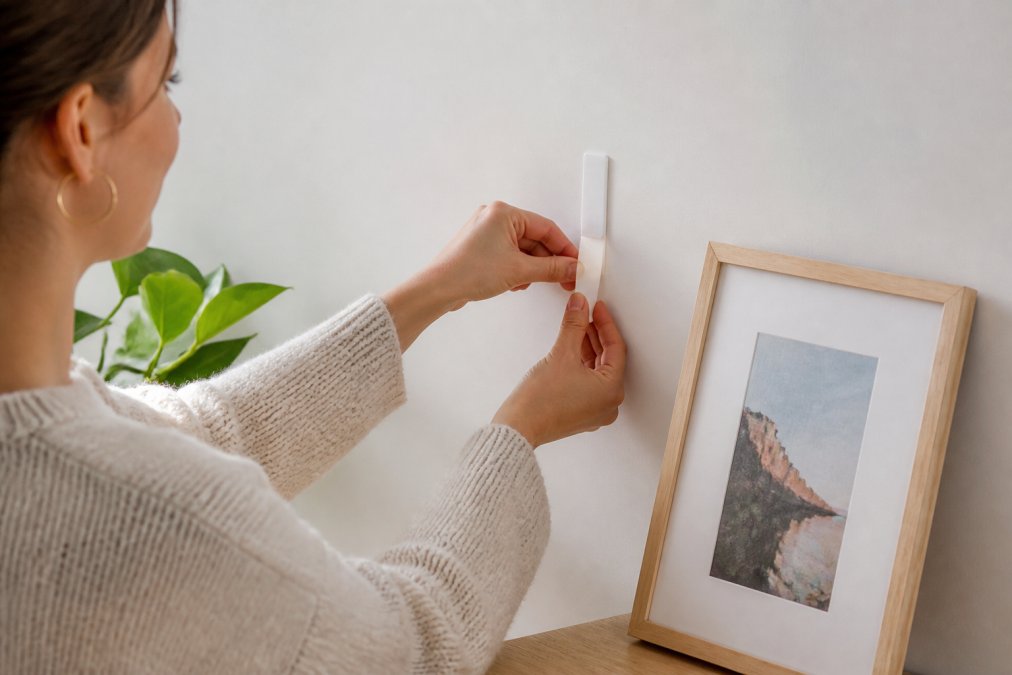
Command Strips, Hooks, and Adhesive Options
Adhesive strips work well for lightweight prints under a few pounds. Heavier canvas needs a different approach. The table below reflects the trade-offs most renters actually hit, not the marketing claims on the package.
| Method | Best For | Weight Limit | Deposit Risk |
|---|---|---|---|
| Adhesive strips | Small prints, lightweight frames | Light (typically up to a few pounds per pair) | Low if removed correctly |
| Adhesive hooks | Medium frames, mirrors | Moderate | Low to moderate |
| Tension rods | Curtains, lightweight tapestries | Light | None |
| Leaning or propped | Canvas, large prints | Any | None |
| Picture rail hooks | Heavy pieces on rail-equipped walls | Heavy | None |
| Over-the-door hooks | Wreaths, lightweight textiles | Light | None |
Surface Prep and Removal: Where Most Deposits Are Lost
Adhesive failure is almost always a surface problem, not a product problem. Textured walls, freshly painted walls (cured less than about 30 days), dusty walls, and walls painted with low-sheen or matte finishes all reduce adhesion and increase the chance of paint peeling on removal.
A repeatable prep sequence that most practitioners find reliable:
- Wipe the target area with isopropyl alcohol and let it dry completely, residue and skin oils are the top cause of early failure.
- Press the strip firmly for the full contact time the package specifies, usually 30 seconds.
- Wait the recommended cure window (often about an hour) before hanging weight.
- Never exceed the stated weight limit. Two strips rated for 3 pounds each do not safely hold a 6-pound frame, the load is shared unevenly.
On removal, pull the tab straight down against the wall, slowly, parallel to the surface, never outward. Pulling outward is what tears paint and drywall paper. If a strip resists, warm it briefly with a hair dryer on low to soften the adhesive, then continue.
Documenting for Deposit Recovery
This is the step almost every decor guide skips, and it is the one that decides whether you get your money back. Before you hang anything, photograph every wall in the unit, wide shots plus close-ups of any pre-existing marks, chips, or nail holes. Date the photos.
Then, when you remove your decor at move-out, photograph the same walls again from the same angles. If a landlord later claims damage, you have a before-and-after record showing the wall was returned to its prior condition.
A few practical anchors for the conversation:
- Normal wear and tear generally covers minor scuffs, small nail holes from picture hanging, faded paint, and worn carpet in traffic areas. These are typically not chargeable.
- Damage generally covers large holes, torn drywall paper, adhesive residue that won't clean off, and stains. These usually are chargeable.
- Many state landlord-tenant statutes require the landlord to provide an itemized written statement of deductions and return the balance of the deposit within a set window (commonly 14 to 30 days, depending on the state). If you receive a deduction you believe is wear and tear, a written dispute citing your dated photos is the standard first step.
State-by-state security deposit return deadlines and itemization rules
Choosing the Lowest-Risk Method for Your Wall
Match the method to the wall, not to the art. On a smooth, cured, semi-gloss wall, adhesive strips are low risk. On a textured or freshly painted wall, skip adhesive entirely and use a leaning vignette, a tension rod, or an over-the-door hook. On a wall with a picture rail, rail hooks are the safest heavy-load option because they leave no hole in the drywall itself.
When in doubt, propping wins. A stretched canvas leaned on a console, shelf, or floor against the wall carries zero deposit risk and zero hardware. It is the method to default to whenever the wall surface is uncertain.
Renter Friendly Wall Art Ideas for Every Room
Renter friendly wall art ideas lean on layout and placement rather than permanent installation. Three approaches cover almost every room.
Gallery Walls, Propped Art, and Leaning Vignettes
A gallery wall built from adhesive strips lets you arrange and rearrange without commitment. Lay the whole arrangement on the floor first, photograph it, then transfer it to the wall.
Propped art is the lowest-risk option of all. Lean a stretched canvas on a shelf, mantle, or floor against the wall. No hardware, no holes, no residue. A piece like Reflecting on Perceptions of Reality works well propped on a console or dresser.

Leaning vignettes combine a large piece with smaller objects at its base: books, a candle, a plant. The layering adds visual interest without a single adhesive strip.
For textiles, a quilt or tapestry on a tension rod adds texture and softens sound in a bare apartment.
Budget-Tiering Your Artistic Home Decor for Renters
Not every renter can spend the same amount, so tier your purchases by impact per dollar and by how many moves each piece will survive. The goal is not to spend the least, it is to spend once on pieces that rehang in every apartment you rent.
A workable three-tier approach, with a concrete allocation rule: put roughly 60 percent of your decor budget into Tier 1 and Tier 2 combined, and hold the remaining 40 percent for one Tier 3 anchor piece you buy only after you have settled into a lease you expect to renew.
- Tier 1 (under $50): Pillows, small prints, textile accents, and removable hardware. High impact, easy to move, low regret. A piece like the Particles Premium Pillow adds color to a couch or bed for under $30.
- Tier 2 ($50 to $200): Stretched canvas prints and mid-size framed art. These anchor a room and are the workhorses of a renter's collection, big enough to read as intentional, small enough to fit a car trunk on moving day.
- Tier 3 ($200+): Large statement pieces and originals. Buy these once you have settled into a longer lease, and buy them because you love them, not because a trend told you to.
The Cost-Per-Move Test
The single most useful filter for renter decor is cost per move. Divide the price of a piece by the number of moves you realistically expect it to survive.

- A $25 poster that curls and yellows within a year and gets tossed at the first move costs $25 per move.
- A $150 archival stretched canvas that survives five moves costs $30 per move, and you still own it.
Run that math before you buy, and the cheap option often stops looking cheap. This is also the mechanism behind the sustainability argument: buying fewer, better pieces that survive multiple moves beats replacing disposable decor every year, which keeps it out of landfills and keeps your budget intact.
Zero-Cost and Low-Budget Moves That Still Read as Art
Budget tiering is not only about what you buy. Several of the highest-impact renter decor moves cost nothing:
- Rearrange what you already own. Rotate existing prints between rooms, restyle shelves, and regroup objects by color before spending a dollar.
- Prop instead of hang. Leaning a canvas you already own costs zero and removes all hardware risk.
- Shop secondhand first. Thrift stores, estate sales, and online marketplaces routinely carry framed art and solid wood furniture at a fraction of retail. Inspect frames for water damage and check that hardware is included.
- Upcycle a piece of furniture. A coat of removable peel-and-stick contact paper on a dated dresser or a set of new knobs transforms a room for a few dollars and reverses cleanly at move-out.
Where to Spend and Where to Save
Spend on the pieces you will look at every day and that travel well: a stretched canvas, a quality textile, a lamp that changes the whole mood of a room. Save on the pieces that are trend-driven, room-specific, or too fragile to survive a move, those are the ones to buy cheap or borrow from a friend.
If you are furnishing a first apartment on a tight budget, resist the urge to fill every wall at once. A single strong Tier 2 canvas on a bare wall reads better than five cheap prints, and it is the piece you will still be hanging three leases from now.
Sustainable and Eco-Friendly Renter Decor Choices
Eco-friendly renter decor means choosing pieces made to last and materials that don't off-gas or require replacement. Archival canvas, natural textiles, and removable products you can reuse all qualify.
Look for prints on archival canvas rather than thin poster paper, which yellows and curls within a year. Reusable adhesive products beat single-use strips. And buying art directly from independent artists, like the visionary work by David Heatwole featured at This Artists Dream, keeps more of your money with the maker instead of a mass-production supply chain.
That last point matters to renters who move often. A piece you genuinely love is one you'll rehang in every apartment, which is the most sustainable choice available.
Frequently Asked Questions
How can I hang art in a rental without damaging walls?
Use removable adhesive strips rated for the weight of your piece, or choose lightweight canvas prints that hang from a single hook. Clean the wall with rubbing alcohol first, press firmly for 30 seconds, and wait an hour before hanging. For heavier pieces, use a small nail and patch it with spackle before move-out. Always check your lease agreement for specific rules about hardware and fixtures.
What are the best renter friendly wall art ideas for small spaces?
Propped art on a shelf or mantel adds visual interest without any hardware. A gallery wall of lightweight prints using removable strips covers a large area without holes. Leaning a stretched canvas against the wall on the floor works well for oversized pieces. Peel-and-stick vinyl murals or temporary wallpaper can transform an accent wall and remove cleanly when you move.
How do I choose the right size art print for small walls?
Measure your wall width and aim for art that covers 60 to 75 percent of the available space above furniture. For a narrow wall under 36 inches wide, a single 14x10 inch canvas print works well. For wider walls, group two or three smaller pieces in a gallery layout. Hang art so the center sits at eye level, roughly 57 to 60 inches from the floor.
Can I use wallpaper in a rental apartment?
Yes, if you choose removable peel-and-stick wallpaper designed for renters. These vinyl rolls apply to smooth, clean walls and peel off without leaving residue when removed correctly. Test a small corner first to confirm your wall paint is compatible. Avoid applying to freshly painted walls or textured surfaces, and follow the manufacturer's removal instructions to protect your security deposit.
Renting doesn't have to mean blank walls and beige everything. The challenge is decorating boldly without risking your deposit or buying pieces you'll abandon at the next move. This Artists Dream offers archival stretched canvas prints, shape-retaining premium pillows, and visionary art by David Heatwole, all designed to move with you. Get started with This Artists Dream and turn every rental into a gallery you can pack up and take along.