
How to Support Independent Visionary Artists in 2026
Table of Contents
- Why Visionary and Outsider Art Need Direct Support
- The Benefits of Buying Art Directly From Artists
- How to Determine Fair Market Value for Art Before You Buy
- How to Promote Independent Artists on Social Media Without Feeling Salesy
- Funding Beyond the Grant: Direct Money That Reaches Artists
- Copyright, Licensing, and Protecting a Visionary Artist's Work
- Curatorial Pathways and Community Engagement for Independent Artists
- Frequently Asked Questions
Last Updated: September 14, 2026
Why Visionary and Outsider Art Need Direct Support
Visionary and outsider art rarely arrives through the traditional gallery pipeline. Its makers work outside formal training, established networks, and the commercial systems that decide whose work gets seen, which makes the work original and the artists financially vulnerable.
At This Artists Dream, we built our model around closing that gap. Every piece of apparel, accessory, and home décor we sell puts money and visibility behind David Heatwole, a working visionary artist. So when people ask how to support independent visionary artists, our answer is practical: buy directly, pay fairly, and carry their work into the world.
The Benefits of Buying Art Directly From Artists
The biggest benefit of buying art directly from artists is that more of your money reaches the maker. Through a gallery or mass licensing platform, the artist's share is negotiated before you ever see the piece. Buy direct and that negotiation disappears.
As a buyer, you get the story behind the work, often from the artist themselves, plus pieces not designed by committee to fit a trend cycle, a relationship, not a transaction.
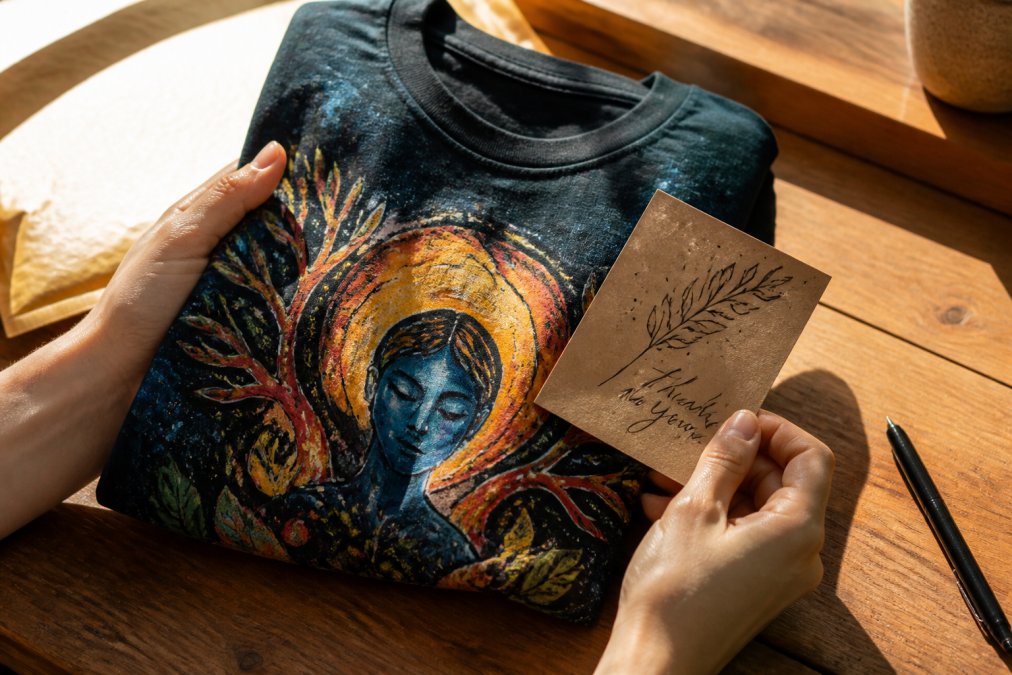
Close-up of hands holding a bold, colorful artist-designed t-shirt next to a small handwritten thank-you card, warm natural light on a wooden table
What Actually Changes When You Skip the Middleman
Skipping the middleman changes who holds power: the artist sets the price, controls the edition size, and decides how the work is presented. You buy the piece the artist actually wanted to make.
That matters most for visionary and outsider artists, whose work resists easy categorization. A gallery that cannot shelve it will not show it; a direct buyer does not need a category.
How to Determine Fair Market Value for Art Before You Buy
Fair market value is the price a willing buyer pays a willing seller when neither is under pressure, set by the artist's own pricing, not a resale platform. Before you buy, look at how the artist prices comparable work across sizes, editions, and mediums.
Three signals separate a fair offer from a lowball one:
- Consistency. The artist charges similar prices for similar work. Wild swings usually mean the artist is guessing, not pricing.
- Edition size. Limited editions and one-of-a-kind originals command more than open-run prints, and the artist should say which is which.
- Labor and materials. A hand-finished piece on heavyweight fabric costs more to produce than a flat digital print. The price should reflect that.
Pricing Signals That Separate Fair Offers From Lowball Ones
A lowball offer usually comes dressed as a compliment: "I love your work, but can you do it for less?" pushes the artist to absorb your discount. A fair buyer asks the price and pays it, or asks about payment plans if it is out of reach.
If you are commissioning new work, agree on scope, timeline, and price in writing before the artist starts. That protects both of you.
How to Promote Independent Artists on Social Media Without Feeling Salesy
Promoting independent artists on social media works best when you share the work, not a sales pitch: post the piece, name the artist, say why it caught your eye. For visionary and outsider art, that formula needs niche-specific moves, because the work does not explain itself the way a landscape does.
Visionary art is dense with private symbols and personal cosmology; outsider art carries a life story that shapes every mark. Generic "so talented" captions flatten both. Treat each post as translation: give the audience one concrete entry point into a piece that otherwise reads as beautiful but opaque.
Practical habits that build real visibility:
- Tag the artist in every post and story so their audience sees your post in their mentions.
- Write one specific sentence about the work instead of generic praise. "The way she layers gold over black is unlike anything I've seen" beats "so talented."
- Link to the artist's own storefront or profile, not to a reseller listing.
- Share process shots and studio photos when the artist posts them. Process content consistently outperforms finished-product posts for engagement.
- Name the symbols. If a piece repeats an eye, a spiral, or a figure, say so and ask the artist what it means. That question is the post.
- Credit the medium and dimensions in the caption. Collectors search by medium, and the detail signals you take the work seriously.
Platform-Specific Tactics for Visionary and Outsider Aesthetics
Different platforms reward different things, and most guides wrongly treat "social media" as one channel.
Instagram rewards carousels and Reels. A strong pattern is a three-slide carousel: the finished piece, a close-up of the most detailed section, and the artist in the studio. The close-up stops the scroll, since visionary work hides its density at thumbnail size. Reels work best as 7-to-15-second studio timelapses set to the artist's own audio, not a trending sound that fights the mood.
TikTok rewards narration. A 30-second video where the artist explains one symbol outperforms a silent slideshow, because the platform pushes watch time and comments. Ask the artist to record the voiceover; the first-person voice is the differentiator.
Pinterest is underused for this niche and is where collectors actually browse. Pin the piece with a descriptive title including medium and theme ("acrylic on canvas, visionary cosmology") rather than a clever phrase; pins keep driving traffic months after posting.
Newsletters are the channel most guides skip. An artist with 200 subscribers opening at 40 percent has a more reliable audience than one with 20,000 Instagram followers at 2 percent reach. Subscribe to an artist's newsletter and reply to it, replies train inbox providers to keep delivering their mail.
What to Avoid
Do not repost an artist's work to your own grid without asking. Visionary and outsider artists are frequently copied by accounts that strip credit, so many watermark or limit resolution. A direct message asking permission takes ten seconds and protects the relationship.
Do not add your own filter or crop. The composition is the work. Cropping a border or shifting the color changes what the artist made.
Do not bundle several artists into one "support small artists" post. It reads as a trend, not a recommendation, and it dilutes each artist's name. One artist per post, every time.
For artists building their own presence, the logic reverses: post the work, explain the thinking, and let the audience find the meaning. Visionary art rewards explanation because the symbols are not obvious. "This figure represents the moment I stopped being afraid" does more for a sale than "new piece available."
National Endowment for the Arts grant resources
Funding Beyond the Grant: Direct Money That Reaches Artists
Grants are the most discussed funding route and often the slowest. Applications take weeks, decisions take months, and the money arrives after the work is finished. Direct funding moves faster and reaches artists who never make it through a grant panel.
Direct support takes several forms:
- Buying the work itself. The simplest and most immediate form of funding.
- Artist funds and mutual aid pools. Small, often unglamorous funds that cut checks quickly for materials, studio rent, or emergencies.
- Patronage and subscription models. Recurring support that gives an artist predictable income instead of one-off sales.
- Revenue-sharing product lines. When a brand puts an artist's work on a product and pays them a share, the artist earns every time the product sells.
That last category is where we operate. Our "This Artist's Dream Deserves Wings" unisex classic tee was created specifically to feed the Matter of Art Fund, fueling future artistic dreams.

"This Artist's Dream Deserves Wings" Unisex classic tee
Matter of Art Fund and Other Direct Artist Funds
The Matter of Art Fund is a direct artist fund tied to our product line: a portion of proceeds from designated pieces goes back to fueling future artistic dreams. It is not a grant program with a panel and a deadline. It is money that moves when a product sells.
Other direct funds work on similar principles: speed and low barriers. If you want to know how to support independent visionary artists in a way that reaches them this month rather than next year, direct funds and direct purchases are the answer.
U.S. Copyright Office guidance on registering visual art
Copyright, Licensing, and Protecting a Visionary Artist's Work
Copyright protection begins the moment a work is fixed in a tangible form. In the United States, registration with the U.S. Copyright Office strengthens that protection and is required before an artist can sue for infringement of a U.S. work. It is inexpensive and worth doing for any piece an artist plans to sell or license.
When you buy art, you buy the physical object, not the copyright. That distinction trips up a lot of buyers. Unless the artist signs a written transfer, the copyright stays with them.
Licensing grants specific, limited permission: to print the image on shirts, use it in a film, display it in a show. Good licenses state scope, territory, duration, and fee. Artists should never sign a license transferring all rights in perpetuity for a flat fee, that is a sale disguised as a rental.
Curatorial Pathways and Community Engagement for Independent Artists
Curatorial pathways for independent artists rarely run through traditional galleries. They run through pop-up shows, artist-run spaces, online exhibitions, and brand collaborations that reach people who would never walk into a gallery. Most guides stop there, leaving artists with venue types and no way in.
The gap in every competing article is the mechanics: how does an artist without gallery representation get a curator to look? What does a proposal contain? What happens after the show? Here is the practical version.
How to Approach a Curator Without Representation
Curators are not the gatekeepers artists assume. Most independent curators are freelancers who build shows around a theme and then look for work that fits. The artist's job is not to prove the work is good, it is to show it fits a specific idea.
A workable approach has four parts:
- Find the curator's actual interests. Read the last two or three shows they organized. Note the themes, the mediums, and the scale of the venues. A curator who builds group shows around memory and ritual is a different target than one who builds them around abstraction.
- Send a short, specific email. Three short paragraphs: who you are, one sentence on what your work is about, and one sentence on why it connects to a show the curator has already done. Attach three to five images or link to a single page. Do not attach a 40-image PDF.
- Include the practical facts. Medium, dimensions, year, and whether the work is available. Curators plan months ahead and need to know what exists and what can be shipped.
- Follow up once, after two to three weeks. One polite follow-up is standard. More than one reads as pressure.
A common pattern is that the first email gets no reply and the second curator does. Volume matters, but only when each email is genuinely tailored. Ten generic emails to ten curators will underperform three specific ones.
Artist-Run Spaces, Pop-Ups, and Juried Shows
Artist-run spaces are the most accessible entry point because the people running them are artists who remember being ignored. Many publish open calls on their sites and regional arts council listings. Juried shows through local arts organizations are another low-barrier route; fees are modest, and the juror's statement often says exactly what they want.
Pop-up shows are the fastest path to a first exhibition: a temporary space, a date, and artists willing to split costs. Empty retail space, community centers, or a rented hall work. Pop-ups rarely sell much, their value is the documentation, press mention, and record line that strengthens the next application.
Online exhibitions deserve more attention. A curated online show with a written statement and fixed run dates gives an artist a citable exhibition credit, which matters for grant applications and residency proposals. The barrier is lower and the documentation lasts.
What to Do After the Show
The work does not end when the show comes down. Three follow-ups convert a single exhibition into a career step:
- Document everything. Installation shots, a list of works with dimensions and prices, and any press or social coverage. This becomes the artist's portfolio packet for the next opportunity.
- Collect contact information from anyone who expressed interest. A simple sign-in sheet at the door, or a QR code to the artist's newsletter, builds the list that makes the next show easier to fill.
- Thank the curator and the venue in writing. A short note is not flattery; it is how a one-time show becomes a recurring relationship.
Community Engagement as the Engine
Community engagement is the engine behind all of it. Artists who show up at local markets, teach workshops, and collaborate build the network that produces opportunities, and sustains a career through slow seasons.
Teaching is one of the most underrated forms of support. A workshop at a community center or library pays the artist, builds a local audience, and gives beginners a reason to care. Many visionary and outsider artists have deep technical knowledge, layering, color mixing, unusual materials, that transfers directly to a class.
For buyers, the same principle applies. Attending a local show, sharing a post, or wearing a piece that starts a conversation extends an artist's reach at no extra cost. Wearing a bold, artist-designed sweatshirt or a hoodie turns your day into a small act of curatorial support, because people ask about the work.


Collaboration matters too: when two artists work together, each brings an audience and both grow. Visionary and outsider artists who collaborate with peers, musicians, or brands expand their reach faster than those working alone.
Americans for the Arts advocacy and resources
Frequently Asked Questions
What does it mean to be a visionary artist?
A visionary artist creates from inner experience rather than observation or trend. The work often carries symbolic, spiritual, or dreamlike imagery that does not fit neatly into galleries or commercial categories. Visionary and outsider art overlap because both sit outside mainstream art-world norms. For buyers, this means the work is usually deeply personal and often produced by artists who handle their own sales, marketing, and shipping, which is exactly why direct support matters so much.
How does buying direct from an artist impact their career sustainability?
When you buy directly, the artist keeps a far larger share of each sale than they would through a marketplace that takes a commission. That money covers studio rent, materials, and the unpaid hours spent creating. It also gives the artist a documented sales record, which helps when applying for grants, juried shows, or consignment deals. Repeat direct buyers create predictable income, and predictable income is what lets an independent artist keep working instead of taking a second job.
What is the most effective way to support an artist financially beyond buying prints?
Buy original work or limited editions when you can, and buy functional pieces like apparel or home décor when you want art you actually use. Wearable and usable art often carries a higher margin for the artist than a cheap print. You can also commission a piece, pay for a studio visit, or contribute to an artist fund. The 'This Artist's Dream Deserves Wings' tee at $25.00 routes proceeds to the Matter of Art Fund, which is a direct way to fund future work.
How can social media engagement help independent visionary artists gain visibility?
Comments, saves, and shares push a post into more feeds than a like ever will. When you share an artist's work, tag them, and add a sentence about why it moved you, you are doing the work an art critic used to do. That kind of third-party endorsement reaches people who would never search for visionary art on their own. It also gives the artist social proof they can point to when pitching galleries, press, or retail partners.