
Empowering Artists for Gift Retail: A Retailer's Guide
Last Updated: November 20, 2026
Quick Summary
Empowering artists for gift retail means building direct, transparent commercial relationships with independent artists so their work reaches gift buyers as finished products, not just framed originals. Choose a payment model on purpose, such as consignment, wholesale, or licensing, and put every term in writing before product development starts.
- Independent artist retail partnerships last when the retailer treats the artist as a co-owner of the outcome, not a vendor filling a SKU slot.
- Wholesale suits reproducible formats like prints, cards, and apparel where you can forecast demand.
- An oral agreement to split profits is the single most common source of artist-retailer disputes.
- Buying a physical painting does not automatically grant the right to reproduce it; negotiate reproduction rights separately in writing.
- Start with one artist, one or two formats, and a defined test window before expanding the roster.
Table of Contents
- Why Helping Artists Is Smart Gift Retail
- Build Independent Artist Retail Partnerships That Last
- How to Buy Art Directly From Artists for Your Store
- Turning Original Work Into Artist-Designed Gifts
- Art Licensing for Gifts Without the Legal Headaches
- Measuring Artist and Retail Outcomes
- Choosing Your First Artist Partnership for Gift Retail
- Frequently Asked Questions
Why Helping Artists Is Smart Gift Retail
Empowering artists for gift retail is the practice of building direct, transparent commercial relationships with independent artists so their work reaches gift buyers as finished products, not just as framed originals. This Artists Dream features visionary art by David Heatwole translated into apparel, accessories, and home décor. The payoff is simple. Gift buyers want something a recipient cannot find on a mass-market shelf, and independent artists want income that does not depend on a gallery taking half.
Most retail guides treat artists as a supply source. That framing is backwards, and it is why so many artist partnerships fizzle out after one season. Artists who understand the retail math become repeat collaborators. Artists who feel used disappear.
Below, we break down the full process: how to find artists, how to pay them fairly, how to turn original work into giftable products, and how to measure whether the partnership is actually working.
Build Independent Artist Retail Partnerships That Last
Independent artist retail partnerships last when the retailer treats the artist as a co-owner of the outcome, not a vendor filling a SKU slot. That means clear agreements, predictable reorders, and credit the artist can point to. It also means choosing a payment model on purpose rather than defaulting to whatever the artist's first email suggested.
Most artist-retailer relationships run on one of three structures, and each shifts risk differently:
- Consignment. The artist retains ownership until the piece sells, and the retailer pays out after the sale, typically keeping a commission on each unit. The artist carries inventory risk; the retailer carries little.
- Wholesale. The retailer buys at a wholesale price and owns the inventory outright, then sells at the manufacturer's suggested retail price or its own markup. The artist gets paid up front and the retailer absorbs unsold stock. Wholesale suits reproducible formats like prints, cards, and apparel where you can forecast demand.
- Licensing or royalty. The artist grants reproduction rights for defined products and earns a royalty per unit sold or a flat fee, often with an advance. The retailer controls production and inventory; the artist trades upside for predictability. Licensing suits retailers with established manufacturing and fulfillment.
A hybrid is common and often wisest: wholesale on proven formats, consignment on experimental ones, and a royalty on any product the retailer manufactures itself.
Payment terms deserve the same specificity as price.
What most guides miss is the paperwork gap. Before any product development starts, agree in writing on:
- Royalty or wholesale structure and the payment schedule
- Approval rights over how the artwork is cropped, colored, or applied
- Territory and channel limits so the artist knows where their work will appear
- Term length and exit terms, including what happens to unsold inventory
- Credit requirements, such as a name on the hangtag or product page
Watch out: an oral agreement to "split profits" is the single most common source of artist-retailer disputes, because neither side defined profit. Put the formula in the document.
If you want to go deeper on building these relationships well, read our guide to supporting independent artists in 2026 before you draft your first agreement.
How to Buy Art Directly From Artists for Your Store
Buying art directly from artists means purchasing reproduction or licensing rights straight from the creator rather than through a distributor or print-on-demand marketplace. The process has five steps, and skipping any of them costs you later.
- Source deliberately. Studio visits, portfolio websites, regional art fairs, and open calls all work. Look for artists whose style fits your customer, not just your taste.
- Ask about existing commitments. An artist may already be licensed exclusively elsewhere in your category.
- Request high-resolution files and color references. Ask how the artist wants the work reproduced. Some care deeply about color accuracy; others do not.
- Negotiate the agreement. Cover royalty, approvals, term, credit, and returns in one document.
- Test small. Order a limited run, sell it, and reorder what moves.
Watch out: buying a physical painting does not automatically grant you the right to reproduce it. Reproduction rights must be negotiated separately, in writing.
Artists price independent work higher than mass-market suppliers, and there are real reasons for that. Our breakdown of why independent art costs more explains the economics so you can set budgets and margins with clear eyes.
Turning Original Work Into Artist-Designed Gifts
Artist-designed gifts work best when the product format respects the original artwork instead of shrinking it into something unrecognizable. A bold visionary painting can carry a tote bag, a greeting card, or a framed small print. It often fails on a tiny keychain.
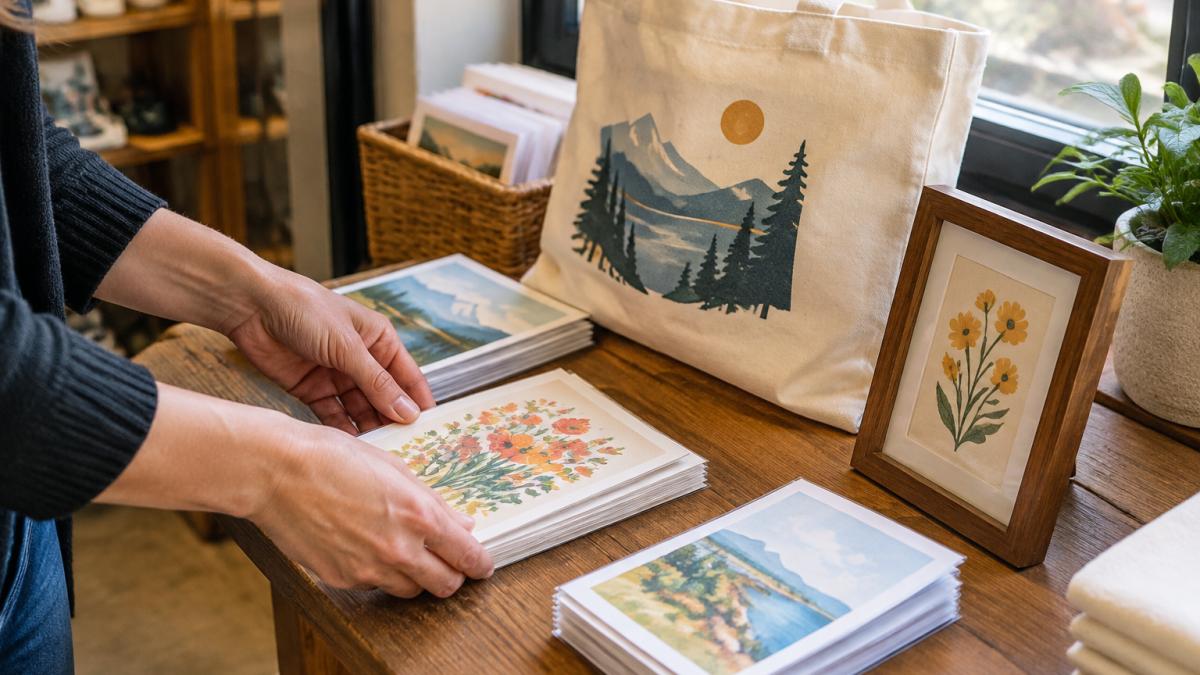
The formats that consistently sell as gifts share three traits: they are easy to wrap, easy to carry home, and easy to explain. Greeting cards, tote bags, mugs, small prints, and wearable pieces all clear that bar.
Art Licensing for Gifts Without the Legal Headaches
Art licensing for gifts is the formal grant of permission to reproduce an artist's work on defined products for a defined period. A clean licensing agreement removes most disputes before they start.
Every agreement we would want to see includes these terms:
- Scope: exactly which products, sizes, and materials are covered
- Exclusivity: whether the artist can license the same work to another retailer in your category
- Compensation: flat fee, royalty per unit, or a hybrid, plus when payment is due
- Approval workflow: how many revision rounds, and how fast the artist must respond
- Termination: notice period and sell-off window for existing inventory
- Credit and marketing use: whether you can feature the artist's name and likeness in promotions
For guidance on the underlying rights framework, the U.S. Copyright Office publishes plain-language material on reproduction and derivative works. It is worth reading before you sign anything.
The thing nobody tells you about licensing is that ambiguity is expensive. A vague clause about "related products" will eventually be tested by a marketer who wants to launch something the artist never imagined.
Measuring Artist and Retail Outcomes
On the commercial side, track sell-through rate by product format, return rate, and reorder frequency. Sell-through is units sold divided by units received in a period. A common pattern among small gift retailers is to set a floor before launch, such as retiring a format that moves less than a third of its initial order within the first selling season, and expanding any format that clears most of its stock. Those thresholds are yours to set, but set them in advance so the review is not a negotiation with yourself.
Return and damage rate matters more for artist products than for commodity gifts, because a cracked mug or a faded print damages the artist's name as much as yours. Log the reason for every return, not just the count. A cluster of color complaints on one format usually points to a production problem the artist can help diagnose.
On the relationship side, track approval turnaround, how often the artist initiates new ideas, and whether they refer other artists to you. Those signals predict longevity better than a single strong quarter. An artist who stops pitching after the first reorder is telling you something.
| What to Measure | Where to Look | What It Tells You | Decision It Should Trigger |
|---|---|---|---|
| Sell-through by format | POS or e-commerce reports | Which gift formats to expand | Reorder winners; retire laggards at season end |
| Return and damage rate | Customer service logs | Whether production quality holds | Pause a format and inspect with the artist |
| Approval turnaround | Email or project tracker | Whether the workflow respects the artist | Simplify rounds or set a response window |
| Artist-initiated proposals | Partnership notes | Whether the relationship is healthy | Schedule a check-in or expand scope |
| Repeat purchase rate | Customer records | Whether gift buyers come back | Adjust merchandising and follow-up |
Run the review on a fixed cadence. Monthly is right for sell-through and returns during a selling season; quarterly is enough for relationship signals. Small businesses rarely need a dashboard for this. A shared spreadsheet updated monthly catches most problems early, and a short written summary sent to the artist each quarter builds the trust that keeps them pitching.
Watch out: measuring only revenue hides the partnership that is quietly failing. If sell-through is strong but approval turnaround has stretched and the artist has stopped proposing new work, you are one season from losing them.
Choosing Your First Artist Partnership for Gift Retail
Your first artist partnership should be small and written down. Chasing a big name before you have a working process is how retailers end up with unsold inventory and an awkward phone call.
Start with one artist, one or two formats, and a defined test window. If the sell-through is there, expand the format range before you expand the roster. Adding a second artist is easier once you can show the first one worked.
Building a gift retail program around independent artists takes more paperwork and more patience than ordering from a catalog. It also produces something a catalog cannot: products with a name, a story, and a person behind them.
This Artists Dream exists to make that model work at scale. We turn visionary art by David Heatwole into high-quality apparel, accessories, and home décor designed to be lived in, not just looked at. Our pieces are built for performance comfort and durability. If you want gifts that carry real creative work into everyday life, explore the collection and see what visionary art looks like when it leaves the frame.
Frequently Asked Questions
How can gift retailers support independent artists?
Start with fair terms: pay a clear royalty or wholesale rate, put the agreement in writing, and credit the artist on the shelf tag and product page. Buy art directly from artists rather than reselling unlicensed prints, and reorder consistently so the artist has predictable income. Retailers can also give artists a say in how their work is displayed and share sell-through data, which helps the artist plan future product lines.
What should retailers consider before selling artist-designed gifts?
Check three things before you commit shelf space: a signed licensing or wholesale agreement that spells out territory, term, and royalty; product quality and durability, since apparel and home decor that fades or shrinks damages both reputations; and fit with your existing gift buyers. Ask for samples, confirm turnaround times, and set a small first order to test sell-through before scaling.
How does art licensing for gifts work?
The artist keeps copyright and grants the retailer or manufacturer permission to reproduce the work on specific products for a set term, territory, and royalty. A typical licensing agreement covers which products are allowed, how many units, approval of samples, and who handles returns. Get it in writing, keep the scope narrow at first, and confirm the artist retains rights to the original artwork.
How can shoppers tell whether a gift supports its artist?
Look for the artist's name on the label, packaging, or product page, plus a stated royalty or licensing arrangement. Artist-designed gifts from a single-artist brand usually make the connection obvious, while marketplace listings can be vague. If the listing does not name the artist or explain how they are paid, ask before you buy. Transparency about artist income is the clearest signal that the purchase actually supports the creator.
